
Solidarity with Ukraine should start at the customs border — not stop there.
Recital (5) of Commission Implementing Regulation (EU) 2026/1457 of 29 June 2026 states unequivocally: “In particular Ukraine should benefit from more preferential distribution of tariff quotas than other FTA partners.”
Yet, just three recitals later, the same Regulation establishes 2022–2024 — the very years when Ukraine’s industry was disrupted by war — as the reference period for allocating country-specific quotas. For Ukraine’s two manufacturers of seamless stainless steel tubes, the result is the opposite of what the Commission intended.
The new 2027 quota allocations offer an opportunity to put things right.
Imagine…
Imagine going to work every morning knowing that a Russian drone or artillery shell could strike your factory — or your own workstation — at any moment.
Imagine producing high-quality stainless steel tubes beneath anti-drone nets, with makeshift shelters of concrete and sandbags where workers can take refuge when the alarms sound.
And imagine doing all this, day after day, to preserve jobs, honour commitments to European customers and keep Ukrainian industry alive.
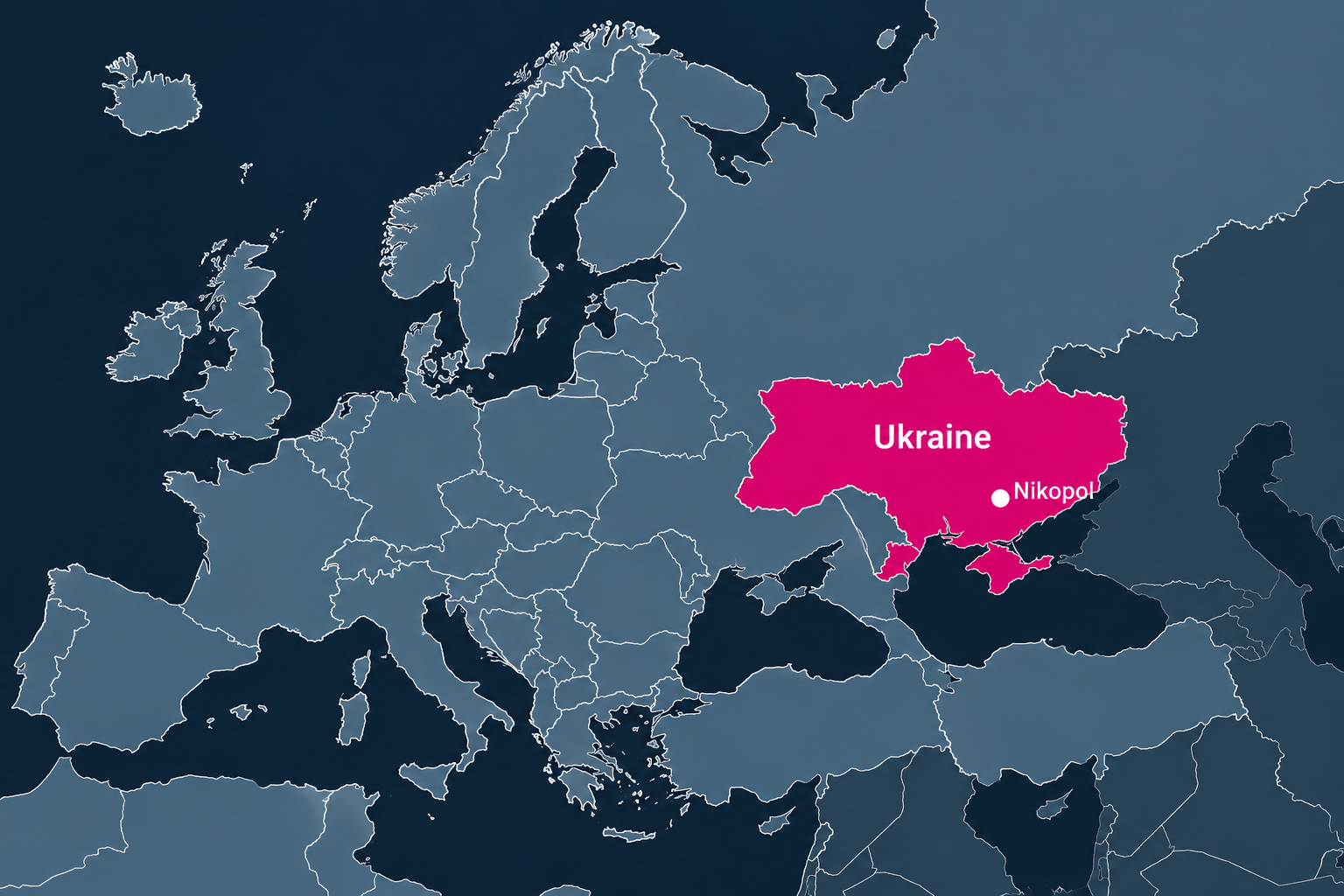
This is everyday life in Nikopol, Ukraine, where Centravis and Oscar — the country’s two manufacturers of seamless stainless steel tubes — continue operating as best they can, with Russian-occupied territory just across the Dnipro River.
Yet, after surviving more than four years of war, these companies now face another obstacle: Europe’s new steel tariff quotas.
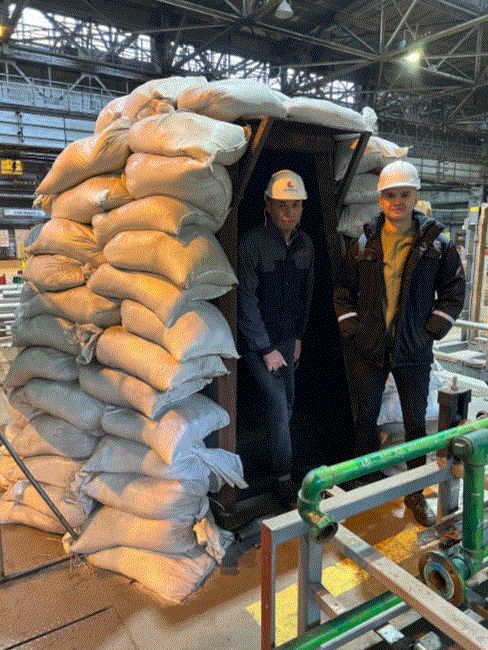
Workers at Centravis, one of the world’s leading manufacturers of seamless stainless steel pipes and tubes, show their workplace shelter.
The War’s Double Impact
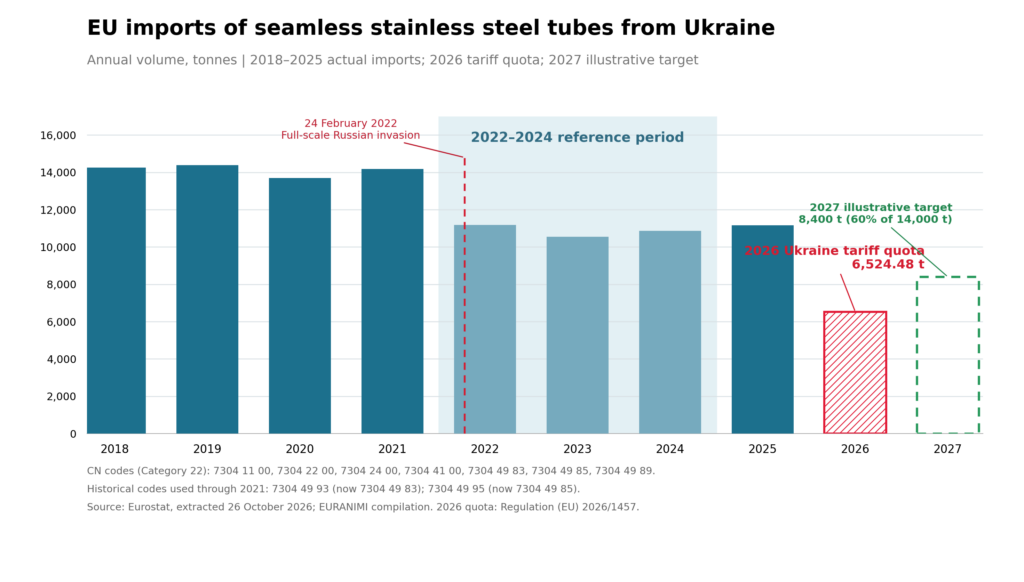
In the four years preceding Russia’s full-scale invasion, Ukraine exported an average of approximately 14,300 tonnes of seamless stainless steel tubes annually to the EU.
Then, on 24 February 2022, Russia invaded Ukraine. Exports initially came to a halt, before gradually resuming under extremely difficult conditions, with manufacturers facing disrupted energy supplies, damaged infrastructure and constant military threats.
Yet, as the Commission explicitly states in recital (8) of Regulation (EU) 2026/1457, the new tariff quota system uses 2022–2024 as the reference period for allocating country-specific quotas. For a country the Commission expressly intends to support, it is difficult to imagine a less appropriate choice: the reference period begins almost exactly with the Russian invasion.
The Commission appears to have honoured its intention to favour Ukraine by allocating 60% of its average imports during that period, rather than the 50% applied more generally. Unfortunately, it applied this preferential rate to the very years when Ukrainian industry was struggling to survive the war.
The result is precisely the opposite of what the Commission intended: instead of being favoured, Ukraine is effectively penalised, with a country-specific annual quota of just 6,524 tonnes — 55% below its pre-war export volumes. Beyond that volume, a prohibitive 50% duty applies.
The FTA-CSQ Quota: Another Casualty of War
Ukraine can theoretically access an additional tariff quota shared with other preferential trading partners. In practice, however, the war puts Ukrainian manufacturers at a serious disadvantage. With Ukrainian ports unsafe and production constantly exposed to Russian attacks, they can hardly afford to accumulate large stocks awaiting shipment. Instead, they dispatch their tubes by truck as products become available.
Indian exporters, by contrast, can ship large quantities by sea and hold them in bonded warehouses at EU ports, ready for customs clearance on the first day of each quarter. In both quarters since the new system took effect in July, the shared quota has been entirely absorbed by Indian imports on the very first day of each quarter. Not a single kilogram has been allocated to Ukrainian manufacturers.
The war penalises Ukrainian industry three times: first by disrupting production and exports, then by making those reduced wartime volumes the basis for future tariff quotas, and finally by preventing Ukrainian manufacturers from competing on equal terms for the additional quota theoretically available to them.
Solidarity should not stop at the customs border
Europe has committed billions of euros to helping Ukraine survive and rebuild its economy. And rightly so. But what sense does it make to support Ukraine financially while restricting its manufacturers’ ability to earn their living through legitimate trade? These companies are not asking for charity. They manufacture sophisticated products meeting demanding European standards, sell them at fair market prices, and supply customers who have relied on them for years.
The EU’s own legislation recognises Ukraine’s exceptional circumstances and provides scope for more favourable tariff quota allocations. EURANIMI therefore calls on the European Commission to restore Ukraine’s guaranteed access to a level reflecting its established pre-war trade. Europe has every reason to help Ukraine rebuild. But rebuilding begins by allowing its surviving industries to keep producing, employing people and trading.
With Friends Like These, Who Needs Enemies?
Imagine surviving years of shelling, power shortages and disrupted supply chains — only to discover that your greatest remaining obstacle to serving European customers is a tariff imposed by the European Union itself.
Surely, that cannot be the outcome Europe intended.
There is still time to put things right. EURANIMI proposes that the Commission retains its preferential allocation of 60% for Ukraine and applies it to the 2018–2021 pre-war average of approximately 14,000 tonnes, rather than to the war-disrupted years 2022–2024. This would give Ukraine a guaranteed annual quota of at least 8,400 tonnes from 1 January 2027.
No special favour is being requested — merely a more appropriate reference period, allowing the Commission’s declared solidarity with Ukraine to translate into meaningful support for its surviving industries.
Related Articles
Case Documents
Please log in as a member to consult all related case documents.
