
Solidarity with Ukraine should start at the customs border — not stop there.
In June 2025, the European Parliament and the Council extended Ukraine’s exemption from EU steel safeguard measures until June 2028. Yet, barely a year later, the new steel tariff regime brought those restrictions back, despite the war continuing unabated.
The new 2027 quota allocations offer an opportunity to put things right.
Imagine…
Imagine going to work every morning knowing that a Russian drone or artillery shell could strike your factory — or your own workstation — at any moment.
Imagine producing high-quality stainless steel tubes beneath anti-drone nets, with makeshift shelters of concrete and sandbags where workers can take refuge when the alarms sound.
And imagine doing all this, day after day, to preserve jobs, honour commitments to European customers, and keep Ukrainian industry alive.
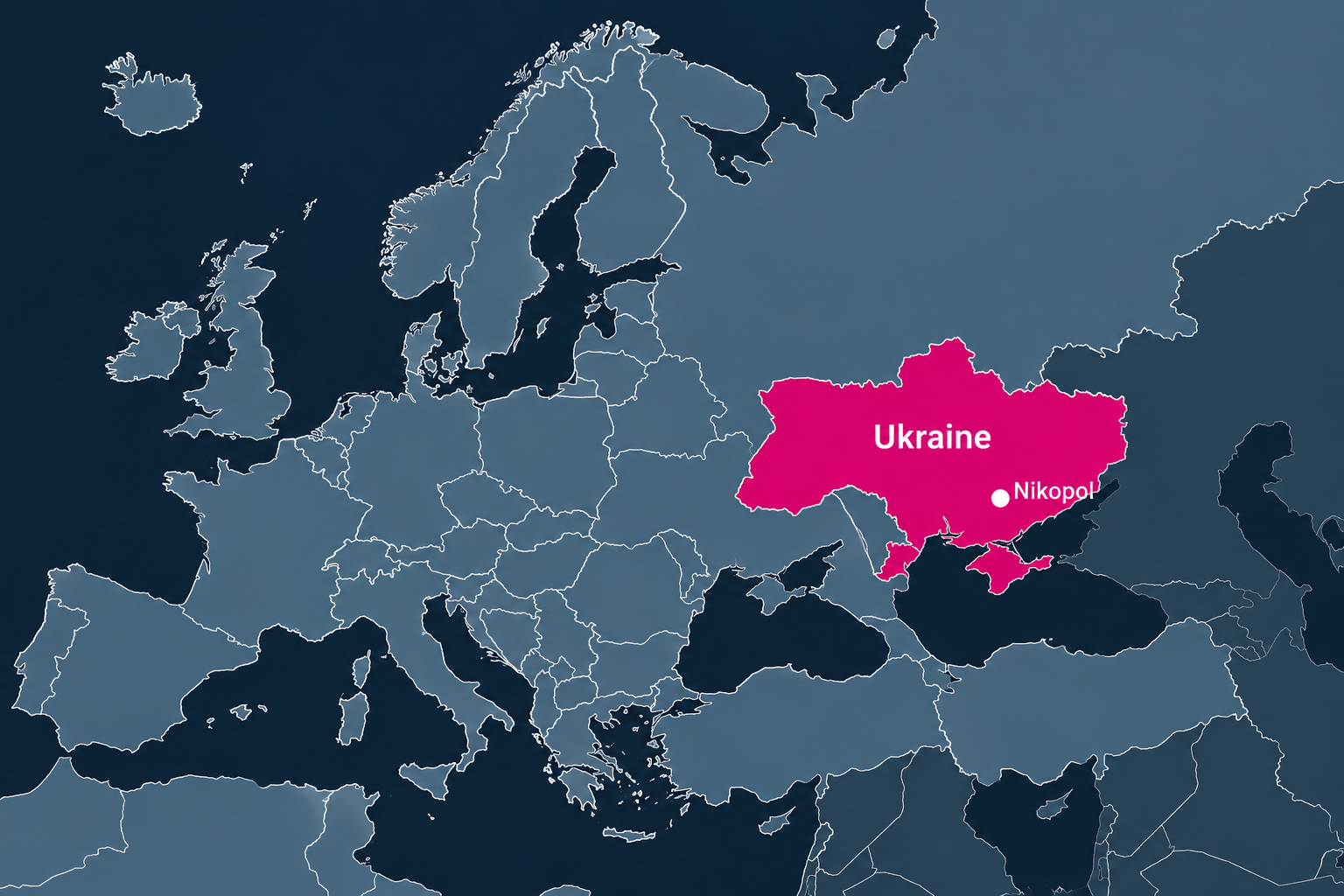
This is everyday life in Nikopol, Ukraine, home to Centravis and Oscar — the country’s two manufacturers of seamless stainless steel tubes — where Russian-occupied territory lies just across the Dnipro River.
Yet, after surviving more than four years of war, these companies now face another obstacle: Europe’s new steel tariff quotas.
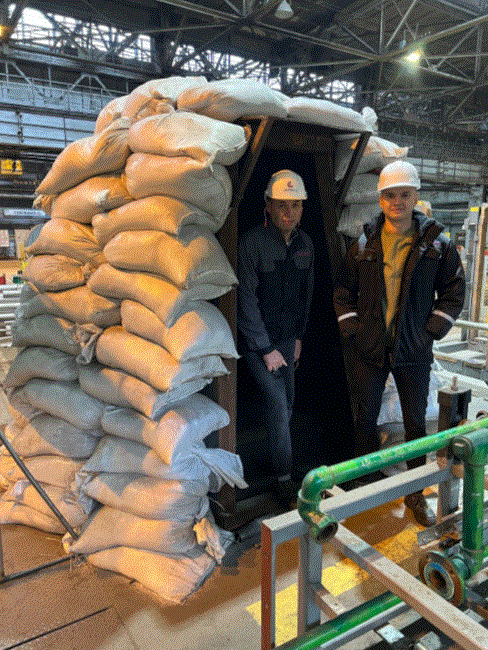
Workers at Centravis, one of the world’s leading manufacturers of seamless stainless steel pipes and tubes, show their workplace shelter.
Solidarity should not stop at the customs border
Following Russia’s invasion in 2022, the EU suspended its steel safeguard measures for Ukraine, allowing Ukrainian steel to enter the European market without quota restrictions. In June 2025, the European Parliament and the Council even extended this exemption until June 2028, recognising the exceptional difficulties faced by Ukrainian industry.
Yet, remarkably, just one year later, the new steel tariff regime reversed that approach. The war had not ended. The circumstances that justified Ukraine’s exemption had not changed. And the new legislation itself still recognises the need for special treatment of countries seeking to join the EU while facing exceptional security threats — a provision that could hardly have been written with anyone other than Ukraine in mind.
Europe has every reason to help Ukraine rebuild. But rebuilding begins by allowing its surviving industries to keep producing, employing people, and trading.
The War’s Double Impact
Under the new tariff regime, recital (5) of Commission Implementing Regulation (EU) 2026/1457 of 29 June 2026 states unequivocally: “In particular Ukraine should benefit from more preferential distribution of tariff quotas than other FTA partners.”
Yet, just three recitals later, the same Regulation establishes 2022–2024 — the very years when Ukraine’s industry was disrupted by war — as the reference period for allocating country-specific quotas. For a country the Commission expressly intends to support, it is difficult to imagine a less appropriate choice: the reference period begins almost exactly with the Russian invasion.
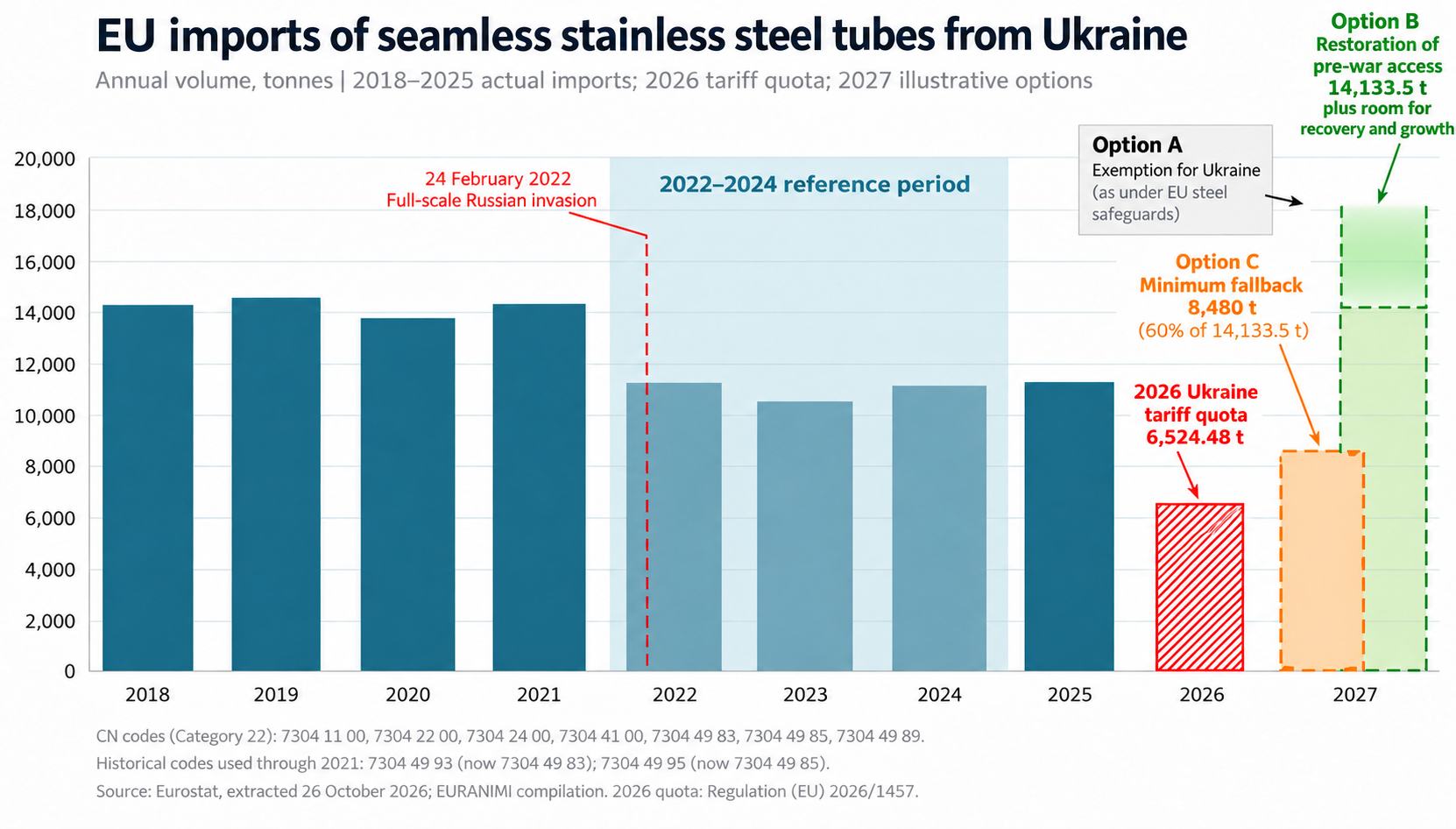
In the four years preceding Russia’s full-scale invasion, Ukraine exported an average of 14,134 tonnes of seamless stainless steel tubes annually to the EU.
Then, on 24 February 2022, Russia invaded Ukraine. Exports initially came to a halt, before gradually resuming under extremely difficult conditions, with manufacturers facing disrupted energy supplies, damaged infrastructure, and constant military threats.
Using the war-affected years 2022–2024 as its reference period, the Commission granted Ukraine a preferential allocation rate of 60%. The result is a country-specific annual quota of just 6,524 tonnes. Had Ukraine not been subjected to Russia’s military aggression, even the standard 50% quota reduction applied to other countries would have resulted in a higher allocation of approximately 7,067 tonnes. In other words, Ukraine is worse off because of the war, despite the preferential treatment intended to help it. Beyond that quota, a prohibitive 50% duty applies.
The FTA Quota-CSQ: Another Casualty of War
Ukraine can theoretically access an additional tariff quota shared with other preferential trading partners: the FTA Quota-CSQ. In practice, however, the war puts Ukrainian manufacturers at a serious disadvantage. With Ukrainian ports and the Black Sea unsafe and production constantly exposed to Russian attacks, building up large stocks in anticipation of future quota openings is not an option. Instead, Ukrainian tubes are transported overland, progressively, as products become available.
Other exporters, by contrast, can ship large quantities by sea and hold them in bonded warehouses at EU ports, ready for customs clearance on the first day of each quarter. In both quarters since the new system took effect in July, the shared FTA Quota-CSQ has been entirely absorbed by Indian imports on the very first day of each quarter. Not a single kilogram has been allocated to imports from Ukraine.
The war penalises Ukrainian industry three times: first by disrupting production and exports, then by making those reduced wartime volumes the basis for future tariff quotas, and finally by preventing Ukrainian manufacturers from competing on equal terms for the additional quota theoretically available to them.
With Friends Like These, Who Needs Enemies?
Imagine surviving years of shelling, power shortages, and disrupted supply chains — only to discover that your greatest remaining obstacle to serving European customers is a tariff imposed by the European Union itself.
Surely, that cannot be the outcome Europe intended.
With new tariff quota allocations due to take effect on 1 January 2027, the Commission has an opportunity to put things right.
The most coherent solution would be to restore Ukraine’s exemption from EU steel import restrictions, as was the case under the previous safeguard regime.
If Ukraine must remain subject to tariff quotas, the Commission should give full effect to the special treatment envisaged in its own legislation and explicitly promised to Ukraine. This should allow Ukrainian industry at least to regain its pre-war access to the EU market — approximately 14,100 tonnes annually — with some additional room to recover and develop.
And even if the Commission insists on maintaining its preferential allocation rate of 60%, the very least it could do is apply that rate to the 2018–2021 pre-war average rather than to the years disrupted by war. This would result in a quota of approximately 8,480 tonnes, compared with the mere 6,524 tonnes currently allocated.
No special favour is being requested — only that Europe’s declared solidarity with Ukraine should translate into meaningful support for its surviving industries.
Related Articles
Case Documents
Please log in as a member to consult all related case documents.
