
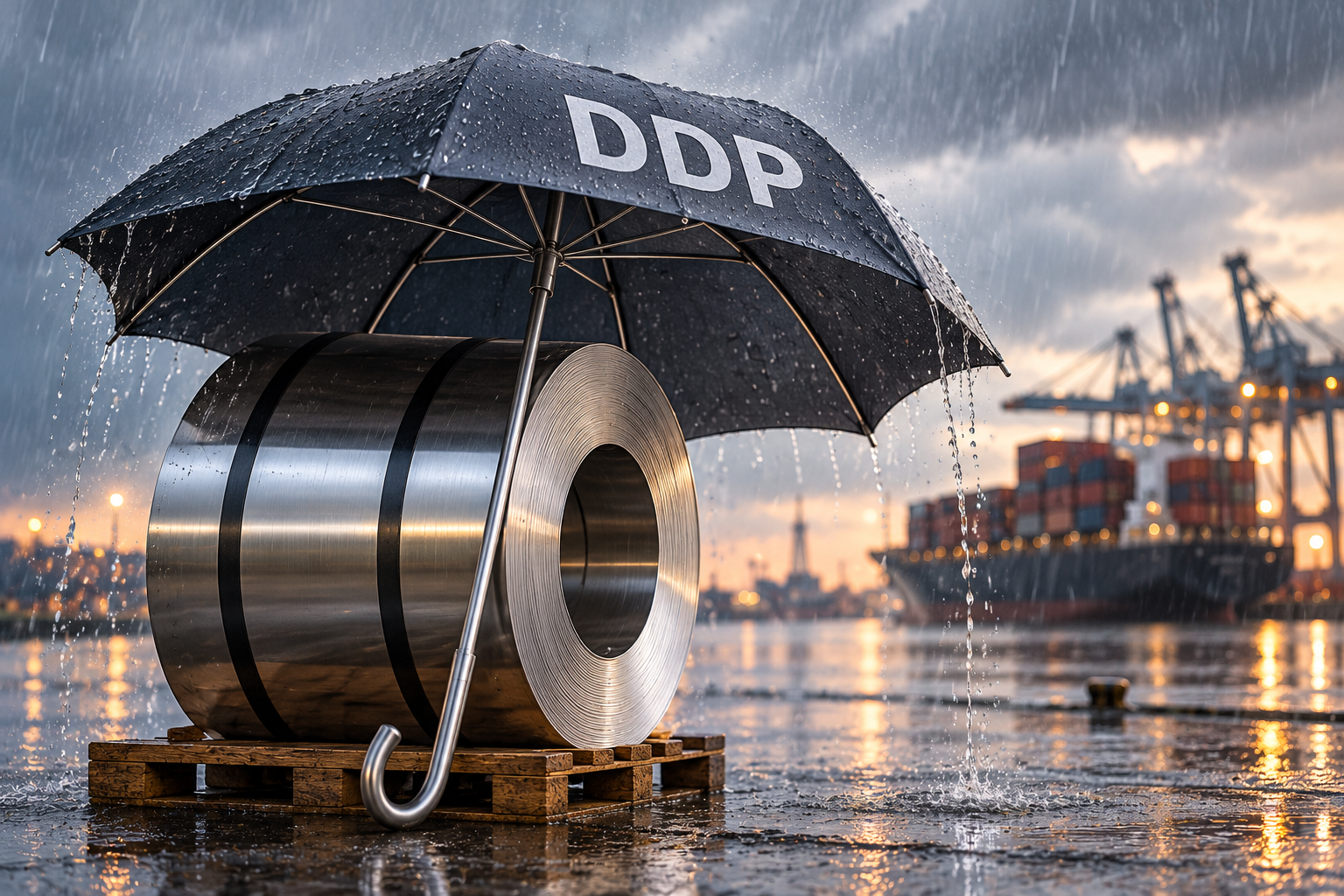
Importing steel into the EU in 2026 comes with two major financial uncertainties.
The first is CBAM. An importer may know the emissions its supplier has indicated, but not whether they will be verified in time, or whether the figures eventually confirmed by an accredited verifier will match those initially provided. If verified actual emissions, including those of the relevant precursors, cannot be used for the 2026 CBAM declaration, considerably higher default values may apply. The importer is therefore uncertain both about timing and about the final CBAM cost.
The second is the new EU tariff quota system for steel. Here, the question is whether an import will actually benefit from the relevant quota: in full, only partially, or not at all. With a 50% duty applying outside the quota, the difference can be considerable.
Little wonder, then, that importers increasingly find it attractive to shift all this uncertainty to the supplier by buying on DDP terms.
DDP eliminates risks. Or does it?
Under DDP, the seller is responsible for clearing the goods for import, bearing the associated duties and taxes, and delivering them to the agreed destination. For CBAM goods, an EU-based authorised CBAM declarant must also handle the CBAM obligations.
The European buyer can therefore be forgiven for thinking the customs hassle, and its costs, are behind them.
So far, so good.
But imagine that some time later, the seller (or the EU-based entity involved in surrendering the CBAM certificates) comes back with a message:
Our authorised CBAM declarant has incurred €X in CBAM certificate costs relating to the import of your goods. Our contract terms were DDP. CBAM costs are not included in the DDP price. Please reimburse €X.
Can the buyer simply reply: Sorry, no way?
That is where things get interesting.
CBAM, a rather peculiar animal
Under DDP, the seller assumes the maximum obligations provided for in the Incoterms® rules. These include import formalities and the associated duties, taxes, and other costs related to import clearance.
At first sight, that might seem to settle the matter.
Except that EU CBAM was deliberately designed so that, legally, its certificate costs are:
- not customs duties;
- not import taxes; and
- not assessed or paid as part of the import clearance of the individual shipment.
There is a further complication: Incoterms® 2020 predates CBAM.
That leaves a genuine question. Does the broad allocation of import-related costs under DDP nevertheless capture the cost of CBAM certificates? Or is this a new type of regulatory cost that Incoterms® 2020 simply does not allocate between seller and buyer?
No clear answer emerged, so we decided to ask the people behind the Incoterms® rules.
We asked the ICC
The International Chamber of Commerce (ICC) referred our question to Christoph Martin Radtke, Chair of the ICC Global Commission on Commercial Law and Practice and former Co-Chair of the Incoterms® 2020 Drafting Group.
His answer was revealing: the ICC does not have an official position on CBAM certificate costs under DDP. Stressing that this was his personal view rather than an official ICC interpretation, Mr Radtke believes that a seller who has accepted DDP will struggle to argue that CBAM certificate costs fall outside the import-related costs it must bear under DDP Article A7.
In other words, the fact that CBAM certificate costs are neither customs duties nor import taxes and are not assessed or paid during clearance of the individual shipment, does not necessarily get the DDP seller very far. In his view, DDP also covers the broader costs of fulfilling the seller’s import obligations.
Coming from someone directly involved in drafting Incoterms® 2020, that is a useful indication. It is not, however, an official interpretation, and the ICC made another point that may ultimately be more valuable.
The easy solution
Incoterms® rules are designed to work worldwide. They cannot anticipate every national, regional, or international regulatory requirement that may affect a transaction. The ICC therefore recommends that parties address specific regulatory requirements in their contract where necessary.
That may be the most useful answer of all.
If you buy CBAM goods DDP, there is little reason to leave the allocation of potentially substantial CBAM costs to interpretation. Agree it.
Such a clause need not be complicated. Depending on the transaction, something as simple as “CBAM costs included” may remove the uncertainty altogether.
Related Articles


Case Documents
Please log in as a member to consult all related case documents.
